

On paper, 2025 is shaping up to be a historic year for safety in America. According to a database maintained by The Associated Press and USA Today in partnership with Northeastern University, the nation has recorded 17 mass killings this year—the lowest number since 2006.
But for families in Barrow County and across Georgia, these statistics ring hollow. While the national definition of “mass killing” (incidents with four or more deaths) suggests a decline, the reality on the ground in Northeast Georgia reveals a different crisis—one driven not by the hardware in the hands of offenders, but by broken homes, missed mental health warning signs, and a judicial system that struggles to intervene before it is too late.
The “Regression” Illusion
The data shows a roughly 24% drop in mass killings compared to 2024. However, criminologists warn this is likely a statistical anomaly rather than a societal victory. James Alan Fox of Northeastern University describes it as a “regression to the mean,” a return to average levels following uncharacteristic spikes in 2018 and 2019.
“Sir Isaac Newton never studied crime, but he says ‘What goes up must come down,’” Fox noted. “Will 2026 see a decline? I wouldn’t bet on it.”
Furthermore, the data masks the violence that stops just short of a fatality count. In 2025 alone, Georgia has seen at least 17 “mass shootings”—defined as four or more people shot—in locations ranging from Savannah to Snellville.
A Case Study in Systemic Failure: Apalachee High School
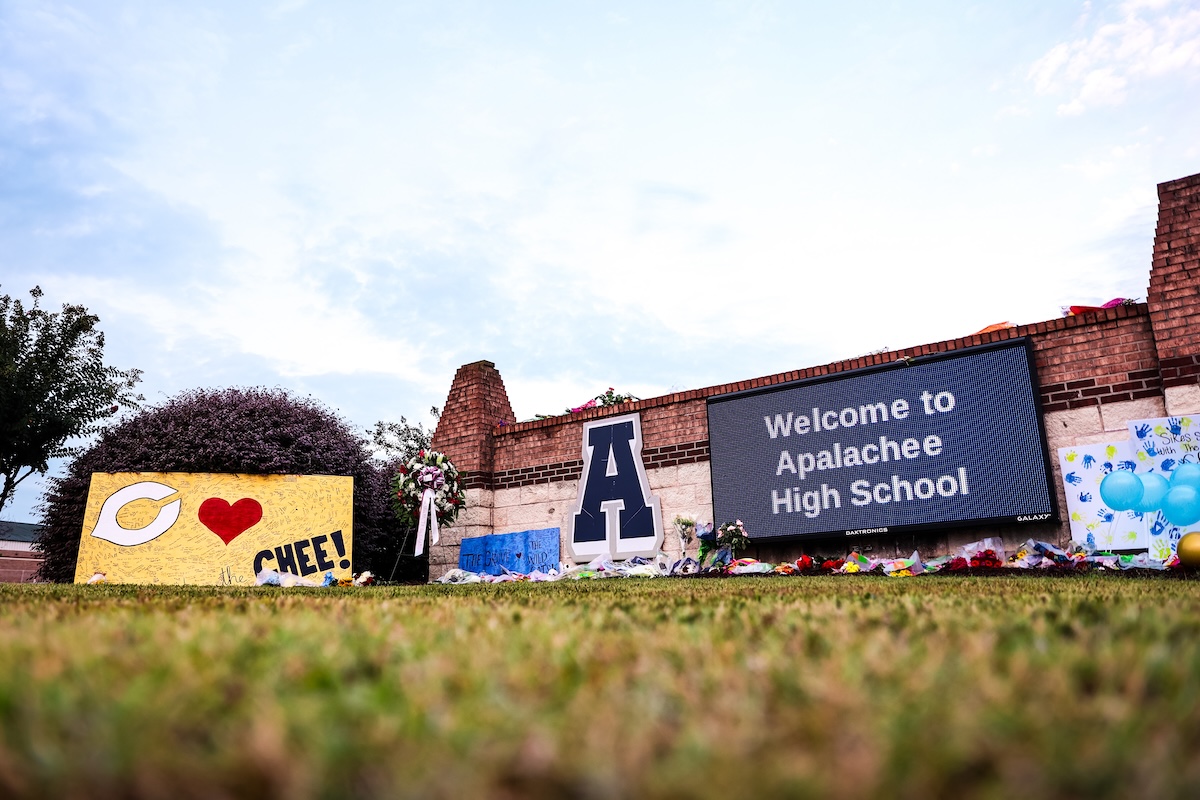
The disconnect between national optimism and local grief is most palpable in Winder, where the community continues to reel from the September 4, 2024, tragedy at Apalachee High School. Four lives were lost—students Mason Schermerhorn and Christian Angulo, and teachers Richard Aspinwall and Cristina Irimie—but the investigation revealed a timeline littered with missed opportunities for intervention.
The 14-year-old shooter, Colt Gray, did not act in a vacuum. His case has become a national litmus test for parental accountability in a two-parent household structure that had fractured.
- Parental Negligence: In a rare legal move, the suspect’s father, 54-year-old Colin Gray, was charged with second-degree murder and involuntary manslaughter. Prosecutors allege that despite knowing his son struggled with severe mental health issues, the father provided him with the weapon used in the attack. This case highlights a critical gap often ignored in safety debates: the fundamental responsibility of child-rearing and the consequences when guardians fail to secure their homes or address their children’s instability.
- Judicial & Law Enforcement Gaps: The system also blinked. In 2023, over a year before the shooting, the FBI and local law enforcement interviewed the Grays regarding online threats. Lacking “probable cause” for an arrest at that time, the teen remained on the path to violence. This “catch and release” approach has drawn sharp criticism from safety advocates who argue that soft-on-crime policies and high thresholds for intervention leave communities vulnerable.
Mental Health: The “People Problem”
While national rhetoric often turns to bans, experts on the ground are pointing to behavioral health. Christopher Carita, a former detective and senior training specialist, suggests the focus is finally shifting.
“It’s always been framed as either a ‘gun problem’ or a ‘people problem’… I feel like for the first time, we’re looking at gun violence as a ‘both, and’ problem nationally,” Carita said.
In Georgia, the “people problem” is acute. The state has struggled with mental health funding, leaving schools as the de facto front line for psychiatric triage. The Apalachee tragedy underscored this when the suspect’s mother reportedly called the school warning of an “extreme emergency” just 30 minutes before the attack—a desperate, last-minute attempt to intervene in a situation that had been spiraling for months.
Missing the Forest for the Trees
While 2025’s low “mass killing” numbers are technically positive, they obscure the broader issue of youth violence. Just this May, four teenagers were shot at a park in nearby Snellville, and in September, three teens were injured in Athens. These incidents, which often involve juveniles, point to a deepening crisis in youth conflict resolution and family structure.
Emma Fridel, an assistant professor of criminology at Florida State University, warns that focusing only on the rare, high-casualty events runs the risk of “missing the forest for the trees.”
“The number one cause of death for children is guns,” Fridel said, noting that suicide and domestic violence remain the quiet drivers of these stats.
For Georgians, the lesson of the last year is clear: Safety will not come from national trends or statistical dips. It will come when the state addresses the difficult realities of mental health care, enforces consequences for violent threats, and demands accountability from parents long before a weapon enters a school.