WASHINGTON (States Newsroom) — The U.S. House agreed Wednesday to consider a bill that would void President Donald Trump’s executive order that strips collective bargaining rights for roughly 1 million federal workers.
The 222-200 vote was a rare bipartisan agreement from the lower chamber to rebuke a policy decision from the president. Thirteen Republicans joined all Democrats voting for the resolution.
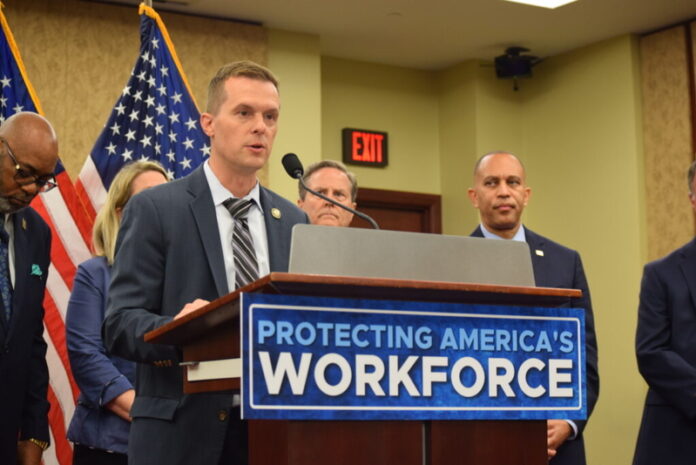
Maine’s Jared Golden, a Democrat, and Pennsylvania’s Brian Fitzpatrick, a Republican, forced the vote by garnering enough signatures from lawmakers under a legislative move known as a discharge petition. The procedure allows rank-and-file members to compel the chamber to vote on measures that are not brought up by the leadership of the majority party, which is how bills typically reach the floor.
Wednesday’s vote was to discharge the bill out of committee and bring it to the floor for a vote. A vote on the bill itself is expected Thursday.
The discharge petition gained the 218 signatures needed from 213 Democrats and five Republicans: Fitzpatrick, Don Bacon of Nebraska, Rob Bresnahan of Pennsylvania, and Nick LaLota and Mike Lawler of New York.
In March, Trump signed an executive order that banned collective bargaining agreements for federal agencies dealing with national security.
Those agencies include the departments of Defense, Veteran Affairs, Homeland Security, State and Energy, along with the National Science Foundation, the U.S. Coast Guard, most entities within the Department of Justice and several pandemic response and refugee resettlement agencies within the Health and Human Services Department, among others.
“Protecting America’s national security is a core constitutional duty, and President Trump refuses to let union obstruction interfere with his efforts to protect Americans and our national interests,” according to the executive order.
Federal law enforcement and firefighters are exempt from the order.
Bargaining agreements for federal employees are somewhat limited. Workers cannot strike or bargain for wages or benefits, but they can push for better working conditions, such as protection from retaliation, discrimination, and illegal firings.