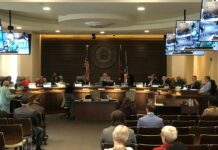
(Georgia Recorder) — Police escorted demonstrators from a Georgia Public Service Commission meeting on Wednesday morning following the introduction of a surprise agreement between commission staff and Georgia Power, the utility it is charged with regulating.
The commission is set to discuss a request from Georgia Power to increase the state’s energy capacity by nearly 10,000 megawatts, equal to about five Hoover Dams, to meet an expected spike in demand because of new energy-hungry data center growth. Staff initially recommended approving only about one-third of the utility’s request and granting conditional approval to another third but changed their recommendation to agree with Georgia Power to move forward with the full request.
Several people disrupted the start of proceedings with chants of “Rein in Georgia Power” and “Power to the people, not Georgia Power,” and were escorted out. According to law enforcement, no one was arrested, and some people were allowed to return to the hearing.
Georgia Power spokesperson Matthew Kent said in a statement that the company welcomes “all public comment during this important process, but these public hearings are in professional settings that require an amount of decorum.”
In exchange for allowing Georgia Power’s energy buildout of at least $16 billion, with 90% of it intended to power data center growth, Georgia Power promised to lower power bills by about $100 a year in its subsequent rate case proceedings. Because Georgia Power and the commission agreed to a three-year rate freeze, the promised savings wouldn’t be considered by the commission until after 2028.
“This plan means more money stays in your pocket while we power Georgia’s future,” said Georgia Power’s head, Kim Greene, in a statement.
But environmental organizations involved in the proceedings weren’t convinced about Georgia Power’s promise that the deal would lead to “downward pressure” on customers’ power bills. Jennifer Whitfield, a senior attorney with the Southern Environmental Law Center, said during lunch break that there is no guarantee the decrease will ever materialize, and it was unclear what the customer got out of the deal.
“It doesn’t mean that in 2029 residential customers will see their bills go down. What it means is that when they do all the various accounting, they promise that if we have a rate case — which we may not — that this class of customers will put downward pressure on the costs otherwise attributed to residential customers, which is just a really long, complicated way of saying, ‘we don’t know what’s going to happen,’” Whitfield said.
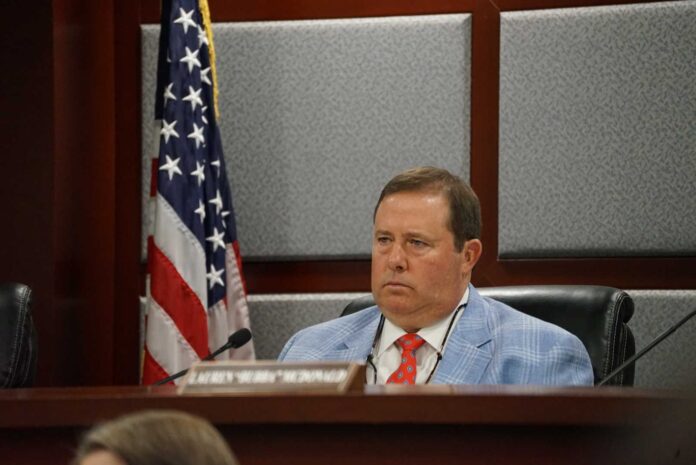
At the start of the hearing, Whitfield asked commissioners for additional time to review the agreement, saying they had not had enough time because they became aware of it on their commute to the hearing. PSC Chair Jason Shaw said that, because of the public hearings, lawyers for the advocacy organizations had the morning to review the agreement and could leave the room if they wished.
“There’ll be some more time there. We will probably not even get to the hearing until after lunch,” Shaw said.
This is a developing story and will be updated.