(Georgia Recorder)- Police escorted demonstrators from a Georgia Public Service Commission meeting on Wednesday morning following the introduction of a surprise agreement between commission staff and Georgia Power, the utility the commissioners are charged with regulating.
Increase in capacity
The commission is set to discuss a request from Georgia Power to increase the state’s energy capacity by nearly 10,000 megawatts, equal to about five Hoover Dams, to meet an expected spike in demand because of the projected growth of energy-hungry data centers. Staff initially recommended approving only about one-third of the utility’s request and granting conditional approval to another third but changed their recommendation to agree with Georgia Power to move forward with the full request.
Several people disrupted the start of Wednesday’s proceedings with chants of “Rein in Georgia Power” and “Power to the people, not Georgia Power,” and were escorted out. According to law enforcement, no one was arrested, and some people were allowed to return to the hearing.
Georgia Power spokesperson Matthew Kent said in a statement that the company welcomes “all public comment during this important process, but these public hearings are in professional settings that require an amount of decorum.”
In exchange for allowing Georgia Power’s energy buildout of at least $16 billion, with 90% of it intended to power data center growth, Georgia Power promised to lower power bills by about $100 a year in its subsequent rate case proceedings. Because Georgia Power and the commission agreed to a three-year rate freeze, the promised savings wouldn’t be considered by the commission until after 2028.
“This plan means more money stays in your pocket while we power Georgia’s future,” said Georgia Power’s head, Kim Greene, in a statement.
But environmental organizations involved in the proceedings weren’t convinced Georgia Power’s promise would lead to “downward pressure” on customers’ power bills. Jennifer Whitfield, a senior attorney with the Southern Environmental Law Center, said Wednesday that there is no guarantee the decrease will ever materialize.
“It doesn’t mean that in 2029 residential customers will see their bills go down. What it means is that when they do all the various accounting, they promise that if we have a rate case — which we may not — that this class of customers (data centers) will put downward pressure on the costs otherwise attributed to residential customers, which is just a really long, complicated way of saying, ‘we don’t know what’s going to happen,’” Whitfield said.
‘Misleading the public’
Stephen A. Smith, executive director of the Southern Alliance for Clean Energy, said in a statement that Georgia Power is misleading the public about the agreement’s potential savings. According to an analysis by the organization that cited the PSC staff’s previous recommendations, the new power plants would raise power bills by an average of $20 per month.
“It’s outrageous that Georgia Power has conspired with Georgia Public Service Commission staff to institute a multi-decade, massive rate increase for all Georgia Power customers and then say that they are helping lower energy costs,” Smith said.
Smith added that these figures do not account for pass-through fuel costs, which would appear as additional charges on customer bills.
“It is a misrepresentation when Georgia Power says that larger users like data centers are paying more when, in actuality, these larger users are causing the new investments that will increase rates for families and businesses,” Smith said.
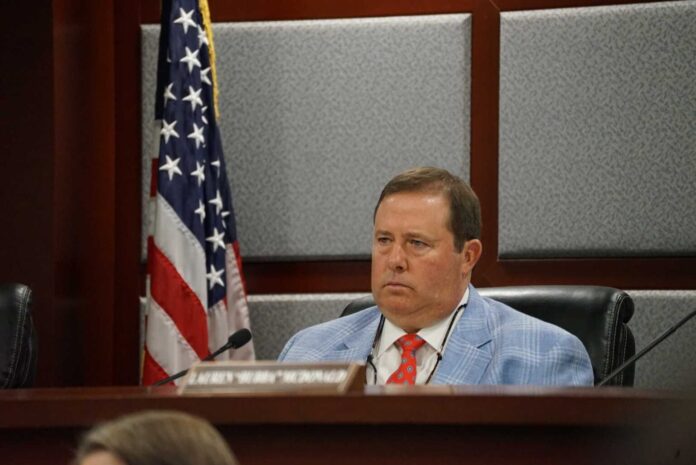
At the start of the hearing, Whitfield asked commissioners for additional time to review the agreement, saying they had not had enough time because they became aware of it on their commute to the hearing Wednesday morning. Commission Chairman Jason Shaw said that, because of the public hearings, lawyers for the advocacy organizations had the morning to review the agreement and could leave the room if they wished to digest the deal.
“There’ll be some more time there,” Shaw said.
Deal a ‘slap in the face’
Brionté McCorkle, executive director of Georgia Conservation Voters, called the deal a “slap in the face” to voters who recently supported candidates campaigning on affordable energy.
“Georgia Power gets everything it asked for. Instead, Georgia families get decades of higher bills and a hollow promise to lower bills years from now,” McCorkle said.
McCorkle suggested the utility pushed for an agreement to finalize its massive expansion request before commissioners-elect Peter Hubbard and Alicia Johnson take office in January, and ahead of the next PSC election in 2026.
“We’re talking about the biggest, most expensive energy decision in state history, and almost none of the cost falls on the companies driving the demand,” McCorkle said. “Today’s stipulation is the result of pressure and heavy lobbying from Georgia Power.”
Arguing that better alternatives exist, Hubbard said in a statement that Georgia can meet the energy demand from data center growth by turning to clean energy options like net metering and requiring data centers to adjust their usage during peak times.
“The people spoke clearly last month. They want affordable, reliable, clean energy in Georgia. We absolutely can provide that here in our great state,” Hubbard said.
The commission is set to make a final decision on the plan on Dec. 19.