(Georgia Recorder) — A state legislative committee is recommending expanded loan forgiveness for doctors and increased funding for mobile screening units to combat a severe shortage of cancer care providers in rural Georgia.
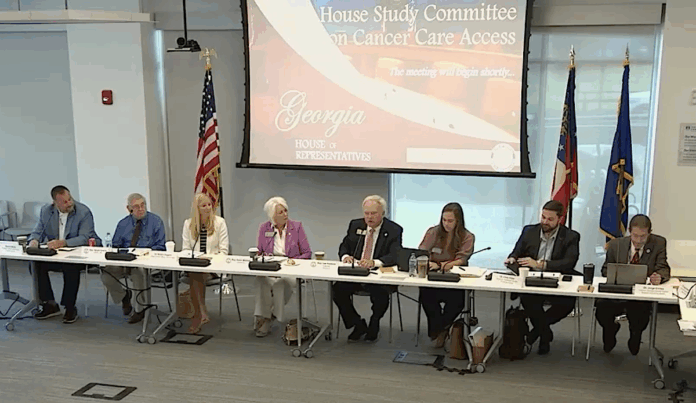
The House Study Committee on Cancer Care Access released its final report following a series of public meetings across the state held last year. The committee, chaired by Rep. Lee Hawkins, a Gainesville Republican, was tasked with identifying barriers to care as cancer cases in the U.S. are expected to rise.
“The rural oncologist is really a dying breed. We don’t have very many oncologists who are setting up shop in rural areas, and part of that is related to the fact that oncology in general is having difficulties with workforce sustainability,” said Dr. Kristin Higgins, chief clinical officer at City of Hope Cancer Center Atlanta and a member of the study committee, in an interview.
Georgia faces a significant disparity in access to care between its metro hubs and rural communities. According to the committee’s findings, although one-fifth of Georgians live in rural counties, only as much as 8% of the state’s oncologists practice there.
To address a shortage of rural doctors specializing in cancer care, the committee recommended expanding the state’s Physician Loan Repayment Program to include specialists practicing in rural areas and increasing the amount of loan forgiveness available. Currently, Georgia offers $150,000 over four years to physicians practicing in rural counties. The report also suggests encouraging rural rotations for medical students.
The committee found that Georgia’s rural counties – or counties with less than 50,000 residents – often face higher poverty rates and hospital closures, making travel to urban treatment centers difficult for patients.
“When you are in smaller communities around the state — I always think about Dublin, Georgia, which is right in the smack dab center of our state — you have to go to Macon or to Savannah or to Augusta or to Atlanta. There are so many that don’t have that access that I have been so fortunate to have,” said Lynn Durham, CEO of Georgia Center for Oncology Research and Education and a three-time cancer survivor who advocated for the study committee’s creation.
According to the Georgia Comprehensive Cancer Control Plan 2024-2029, which calls for increased attention to addressing disparities among cancer deaths, minority and rural populations are disproportionately affected by cancer mortality. Men are also more likely to die from cancer than women.
“I think Georgians deserve access to cancer care close to home. I hear all the time that people want to be with their support systems when they’re going through one of the toughest journeys of their life,” Durham said. “They want to be home and get the best possible treatment they can right here.”
To improve early detection, the legislative panel’s report recommends supporting the use of mobile cancer screening units in rural and underserved areas, such as the Brunswick-based Southeast Georgia Health System Wellness on Wheels. The mobile health clinic provides free or low-cost breast cancer screenings and travels to surrounding counties, such as Glynn, Brantley, Camden, Long and McIntosh counties.
“In 2025 alone, the WOW mobile mammography unit performed approximately 100 site visits with over 400 patient encounters,” said Chad Roberson, director of imaging services at Southeast Georgia Health System.
But running a mobile clinic presents its own challenges. Roberson said that the mobile unit operates “both a clinic and a heavy-duty truck, requiring additional repairs and regular maintenance to perform effectively.” He said that with such a specialized vehicle, issues can arise during periods of high use, increasing costs and causing downtime. He also said the mobile units require health care workers willing to travel long distances and work irregular hours.
The committee also proposed increasing the percentage of tobacco settlement funds appropriated for cancer prevention and screening. Georgia has received about $4 billion from the master settlement agreement with the tobacco industry over the last 27 years, with about $600 million dedicated to cancer-related activities.
Advocates argue that funding for access to cancer care is crucial as federal funding cuts to Medicaid from H.R.1 passed over the summer, which along with expiring Affordable Care Act subsidies, is set to reduce health care funding by more than $50 billion by 2034, according to a November 2025 report from the Georgia Health Initiative,
Fabienne Antoine-Nasser, government relations director with American Cancer Society Cancer Action Network, urged the state to increase funding for cancer-related programs, particularly the tobacco use prevention program, a state program that was discontinued in May due to federal cuts at the Centers for Disease Control and Prevention. Antoine-Nasser suggested raising taxes on tobacco, which could generate $350 million in annual revenue if increased by $1.50 per pack, would help address federal funding gaps.
“I believe that taking a really staunch look at (raising tobacco taxes) … would have such a great impact and really help Georgians who are pre-diagnosed and want to be able to get access to prevention measures, or post as well who want to get access to care,” Antoine-Nasser said.
The committee report also called for supporting the Georgia Cancer Center at Augusta University in its pursuit of National Cancer Institute designation. Currently, the Winship Cancer Institute at Emory University is the state’s only NCI-designated comprehensive cancer center, and establishing a second in another region of the state could provide patients with greater access to a wider range of treatments through clinical trials.
While the committee did not recommend full Medicaid expansion, a long-standing goal for some health advocates like Antoine-Nasser, it did recommend simplifying Medicaid access, enrollment and renewal for pediatric patients and addressing reimbursement rates for oncology-related codes. American Cancer Society Cancer Action Network sent Hawkins a letter in July outlining how federal budget cuts under the Trump administration could affect access to care, saying that policies could cut Medicaid funding for Georgia by an estimated $8 billion over the next decade, with $2.2 billion of those cuts specifically falling on rural areas.
“Protecting and strengthening Medicaid access and access to care is going to be so imperative,” Antoine-Nasser said, pointing to estimated losses of health care coverage due to expiring ACA enhanced tax credits. If these tax credits expire, which the House is set to vote on a three-year extension in January, the GHI report projects that 340,000 Georgians will become uninsured.
Hawkins said in an interview that because of funding uncertainty at the federal level, he is not sure if he can move forward with any recommendation, at least not until the impact of federal funding cuts becomes clearer.
“As of right now, until that shakes out, I do not have any proposed legislation,” Hawkins said. “Just about all the recommendations would need to be funded, and with the One Big, Beautiful Bill, our health care funding is up in the air right now.”
The chairman also seemed concerned about the impact from the expiring Affordable Care Act subsidies, saying that without a federal fix, insurance costs could skyrocket for Georgians.
“The numbers that I read, it looks very depressing for individuals being able to afford their insurance. I mean, some of the policies are doubling in cost,” Hawkins said.
Lawmakers can consider the recommendations in the upcoming legislative session, which starts Jan. 12, and Higgins was optimistic they would find bipartisan support.
“(Access to cancer care) is not going to be controversial. It’s not going to be a controversial area of funding,” Higgins said. “Everybody is affected by cancer.”