(Georgia Recorder) — The Georgia Department of Public Health is navigating a period of financial uncertainty due to the Trump administration’s proposed cut in federal funding, state leaders said Wednesday. Some view the shift as an opportunity to focus on Georgia-specific priorities, while others raised concerns about the state having to fill in spending gaps down the road.
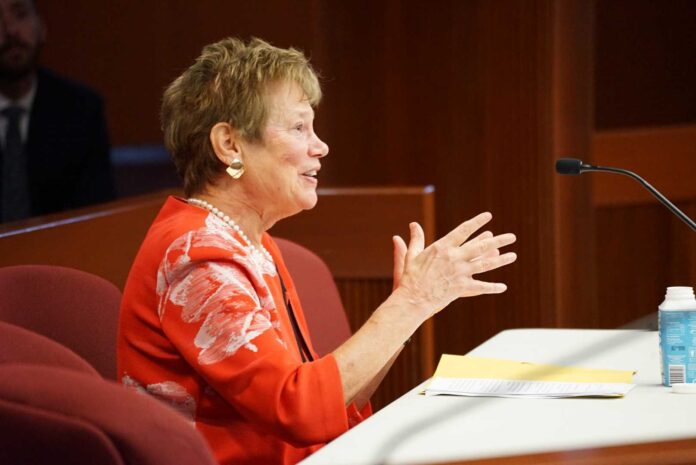
During the first meeting of the House Study Committee on Evaluating Funding for Public Health, state Health Commissioner Dr. Kathleen Toomey said potential budget cuts to public health provide a chance to prioritize the state’s approach to public health, adding that the current shifts in federal funding are not the first time Georgia has faced such changes.
The state has a long history of adapting to “episodic” funding adjustments, she said, and the current situation could be a chance to focus on what the state and local communities need most, rather than following a universal federal model.
“As we’re seeing these changes at the federal level, it’s giving us an opportunity to look at what is important for us, because we often apply for grants that may or may not have been relevant,” she said. “They weren’t developed with our state specifically in mind, with our data, and we were following guidelines that were universal across every state,” Toomey said.
She said the Maternal, Infant, and Early Child Hood Home Visiting Program, which provides home visits to expectant and new parents who are at-risk for poor health outcomes, “reflects exactly what public health should be.” The program, which she said was created using data collected by clinicians and epidemiologists in local communities, provides care tailored specifically to each family’s needs, such as addressing issues like transportation barriers.
“[The program is] specific to that community … you will see that it really is quite different from one county to another, one community to another, because it reflects the needs of that community. That’s public health,” Toomey said.
William Bell, the state health department’s chief financial officer, said that the total appropriation for fiscal year 2026 is $922.5 million, with federal funds budgeted at $464.8 million. He said that the most significant impact occurred in March 2025, when 11 federal COVID-19 funding sources were terminated, resulting in a reduction of $323.7 million in unspent funds from an initial $877.6 million awarded.
“DPH is a predominantly federally funded agency, with around half of our FY ‘26 budget comprised of federal funding sources,” he said.
U.S. senators from both parties recently pushed back against Trump’s proposal to cut medical research and health services funding and instead agreed to increase spending for fiscal year 2026, which starts October 1. Sen. Susan Collins, a Republican from Maine and chair of the Senate Appropriations Committee, said that the appropriation bill “prioritizes funding to make Americans healthier.”
Lawmakers on the study committee, while acknowledging the opportunity, expressed some concern about the financial gap.
Swainsboro Republican Rep. Butch Parrish said he didn’t need an immediate answer but asked Toomey what the state will do if the reduced federal funding continues long-term.
“Obviously, we can help some, but I don’t think we can make up all of those dollars,” Parrish said and encouraged Toomey to evaluate programs that aren’t “working as we thought.”
Carolyn Mullen, senior vice president of government affairs at the Association of State and Territorial Health Officials, who presented a national perspective on impending budget cuts, said that states across the country, regardless of which party is in charge, agree that they need more flexibility with federal funds, as current restrictions make it difficult to allocate money where it is most needed.
“It’s very difficult for many states when the funding is very restrictive, and it prevents the movement of dollars,” Mullen said.
Rep. Dexter Sharper, a Valdosta Democrat, said after the meeting that he believes Georgia has no choice but to find a way to make up for the financial shortfall to ensure citizens do not experience a reduction in services.
“Georgia as a whole has to look for ways to get funding to help subsidize what we’re going to be missing from the federal government,” he said. “We’re also trying to ensure that even at the county levels, they are able to understand that we all got to get this together and make sure we get the funding we need without cutting the services to the people.”
Sharper said this will require a collective effort at both the state and county levels. He said the committee is taking the issue “very seriously” and that they want to avoid cutting any necessary services. In addition to seeking funding from counties, he hopes to work with the governor to secure additional funding for the state health department, particularly for salaries, which he believes will help make the workforce more competitive and ensure the state can retain top talent to continue serving the public.
“The counties more than likely are going to have to contribute a little bit more to what they’re already contributing, and the state is going to have to contribute more than we’ve been contributing to try to catch these shortfalls,” Sharper said.