(Georgia Recorder) — Fulton County District Attorney Fani Willis is calling on the Georgia Supreme Court to dismiss a subpoena to answer questions from a state Senate committee investigating her historic 2023 indictment of President Donald Trump.
Former Gov. Roy Barnes, an attorney arguing on Willis’ behalf, told justices that a subpoena issued by the Senate Special Committee on Investigations is moot.
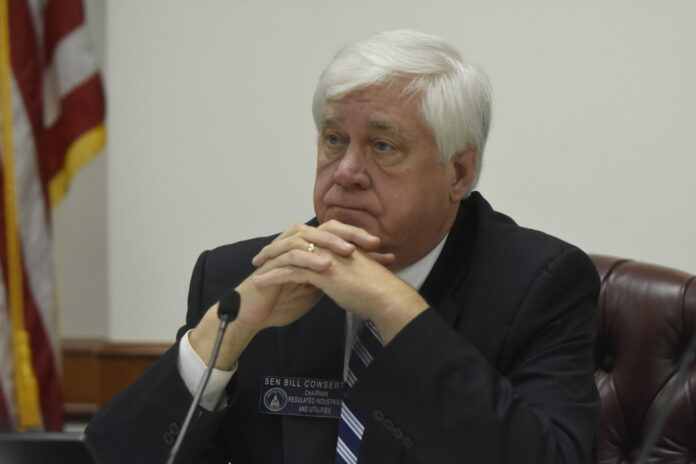
Barnes argues that the committee, led by Athens Republican Sen. Bill Cowsert, who is running for Georgia attorney general next year, does not have the power to issue subpoenas under state law. Barnes said a single-chamber committee cannot subpoena testimony unless it is empowered to do so by statute or by the General Assembly as a whole.
The state’s highest court heard oral arguments on the matter Tuesday.
“For over 150 years, the General Assembly has been very reluctant, particularly when it is only one house of the General Assembly, of giving to a regular or special committee of either house the right to exercise the power of subpoena, and for good reason,” Barnes said.
Barnes said that reluctance helps protect the balance between the branches of government, giving the example of a 2021 effort in the Montana Legislature seeking to subpoena the emails of Supreme Court justices there in an effort to root out alleged bias.
Barnes further argued that the subpoena is not valid because it was issued in August 2024 under the 157th General Assembly of Georgia. That body dissolved in January when the 158th General Assembly was sworn in, Barnes said.
“The General Assembly dies and has no further effect when a new General Assembly comes in,” he said.
Barnes said that Willis plans to appear before the committee on Dec. 17 pursuant to another subpoena filed in November, after the passage of a law sponsored by Cowsert granting new powers to investigatory committees, including subpoena powers.
Attorney Josh Belinfante, arguing on Cowsert’s behalf, said the original subpoena is not moot.
“There is simply zero constitutional text to support that argument, and there is no reason this court should adopt it now,” Belinfante said. “Nor does the fact that the witness has agreed to testify on Dec. 17 change the calculus today.”
Belinfante indicated that Willis testifying could largely resolve the issues at hand, but he also expressed skepticism that she will do so.
“We remember that we had dates before and it did not work out,” he said. “We hope that it does.”
Willis has been resisting calls to appear from the start. In October, Cowsert said the parties reached an agreement that Willis would testify at a November hearing, but when the day came, she did not appear, with the committee citing a scheduling conflict.
Willis’ election interference case centered on Trump’s now-infamous phone call with Georgia Secretary of State Brad Raffensperger in which Trump asked Raffensperger to “find” enough votes to overturn the election.
Co-defendants were also accused of acts including an intimidation campaign against poll workers, a breach of Coffee County’s election systems and a plan to certify a false Trump victory. Four of the 18 alleged co-conspirators pleaded guilty and agreed to testify against Trump and the other defendants.
But Willis’ hopes of taking the case to trial turned to dust after a romantic relationship with a special prosecutor she hired for the case led to accusations of a conflict of interest and her ultimate removal from the case. Late last month, a Fulton County judge dismissed the case once and for all after a special prosecutor found that charging a sitting president was unrealistic.
The section of the state constitution organizing the Legislature states that there “shall be a different General Assembly for each two-year period.” The justices appeared to back up Barnes’ argument that the Legislature that issued the subpoena is no longer around to enforce it.
Chief Justice Nels Peterson said the Legislature is the only state body described in the constitution as reconstituting in that way.
“There’s no other place in the constitution that I’m aware of that provides that, say an executive branch agency or a court becomes different simply because the people constituting the entity change over,” said.
Peterson also appeared to agree that the second subpoena carries greater authority because of Cowsert’s bill.
“I think we would be in a much more challenging constitutional space had the General Assembly not acted in 2025, both the House and the Senate, to confer this power of subpoena on committees that now has been exercised in this most recent subpoena that service has been acknowledged,” he said.
Following arguments, Peterson told the sides that they would have a resolution within the time required by the constitution, which means the end of March at the latest, but he said the court will look forward to a status update follow Dec. 17, when Willis is supposed to appear before Cowsert’s committee.