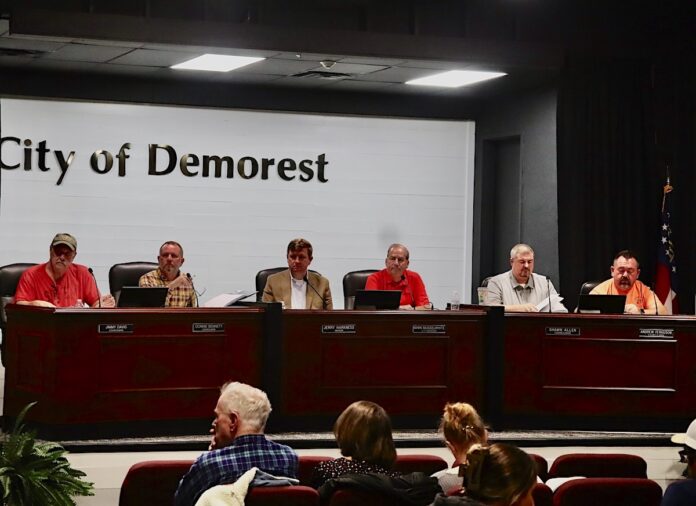
DEMOREST, Ga. — Demorest City Council unanimously approved a new water and sewer rate structure for 2026 Tuesday night after city officials presented multiple scenarios aimed at addressing rising infrastructure costs while limiting impacts on most residential customers.
City Manager Mark Musselwhite told council members during a work session that staff and consultants developed four different rate scenarios as part of an update to the city’s 2023 water and sewer fund study. Musselwhite said the goal was to determine how best to balance fairness, financial sustainability and long-term system needs.
The study follows standards set by the American Water Works Association, Musselwhite said, emphasizing that the proposed rates were based on established industry practices.
“This is not just some willy-nilly numbers picked out there,” Musselwhite said. “They are following the American Water Works Association standards.”
Paying the fair share
Musselwhite said the primary focus of the study was a cost-of-service allocation, which determines how much different customer classes should pay based on demand patterns, infrastructure required to serve them and their location within the system.
“Part of the study is making sure customers are paying their equitable fair share for how they’re using the water and sewer service,” he said.
Council members ultimately adopted the scenario built around that cost-of-service approach. Musselwhite said projections from the 2023 study proved highly accurate, with revenue estimates within 1.6% of actual figures and expense projections within 3%, lending credibility to the updated model.
“Water and sewer fund expenses have increased an average of 15% annually over the past five years, driven largely by repairs, maintenance, capital outlays and chemical costs associated with aging infrastructure,” Musselwhite said. He noted the city maintains 435 miles of water lines and supplies roughly 70% of the county’s water.
Rates based on demand and impact
During his presentation, Musselwhite provided examples showing how the adopted rate structure would affect different users. He said base residential rates inside and outside the city would remain largely unchanged, while high-volume commercial and institutional customers would see increases tied to usage and system demand.
In one comparison, Musselwhite showed that large employers such as Piedmont University, schools and industrial facilities could see monthly increases ranging from several hundred dollars to several thousand dollars, translating to annual increases of roughly $4,000 to more than $10,000, depending on water usage, meter size and infrastructure needs. Musselwhite said the intent of the model is to ensure customers who place the greatest demand on the system pay a larger share of its costs.
“If I have to run a water line 10 miles to you, and I run water to a house right here, it should cost more,” Musselwhite said. “That’s part of getting to a fair-share system.”
Mayor Jerry Harkness and council members weighed the economic impact of the changes during debate.
“I think the only thing that I see in here is just some of those higher-end users getting hit really hard,” Harkness said. “This is something that will affect our economy and will affect everyone in our community.”
Councilman Shawn Allen said he shared those concerns but supported the adopted scenario as the most balanced of the four options presented. Harkness noted that even under the approved plan, “those users are employers who get hit pretty hard.”
Council members voted unanimously to approve the rate structure recommended by city staff and consultants.
LMIG Grant
The council also unanimously approved the city’s 2026 Local Maintenance and Improvement Grant (LMIG). Musselwhite said the grant will provide about $54,000 when combined with the city’s required 30% match, an increase of roughly $4,700 from 2025. The funding will be used to resurface portions of Laurel Avenue, Rusk Avenue and West Central Avenue, with bids expected in April and construction planned for July or August.
Home Rule Amendments
Following a public hearing, the council approved four home rule amendments to the city charter. City Attorney Thomas Mitchell said the amendments update provisions related to the sale or lease of city property, ordinance procedures, the powers and duties of the mayor, and contracting requirements. Each amendment passed individually and without objection.
As part of those changes, Harkness appointed Donnie Bennett as mayor pro tem, and the council approved Allen as an authorized check signer.
The council also voted to declare a 1997 Simon ladder truck surplus. Musselwhite said the truck has been out of service for months and has little resale value due to obsolete components and the lack of available replacement parts. The truck will be advertised for auction with a minimum bid.