CORNELIA, GA — A proposed 216-acre annexation and rezoning along the Highway 365 corridor — the largest growth proposal Cornelia has considered in years — died Tuesday night without a vote after an emotional, 3.5-hour public hearing, an unexpected clerical error, and a failed motion to repost the ordinance.
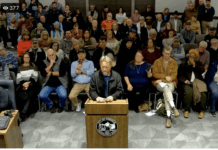
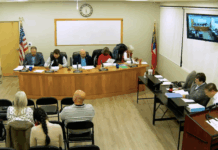
A Cornelia City Commission meeting that typically lasts less than an hour stretched past 9:30 p.m., with more than 100–150 people crowding into the standing-room-only chambers. Most who spoke did not live inside the city limits but in nearby communities such as Level Grove, Mud Creek, Baldwin, Alto, or Clarkesville. Nearly all urged the city to halt the project.
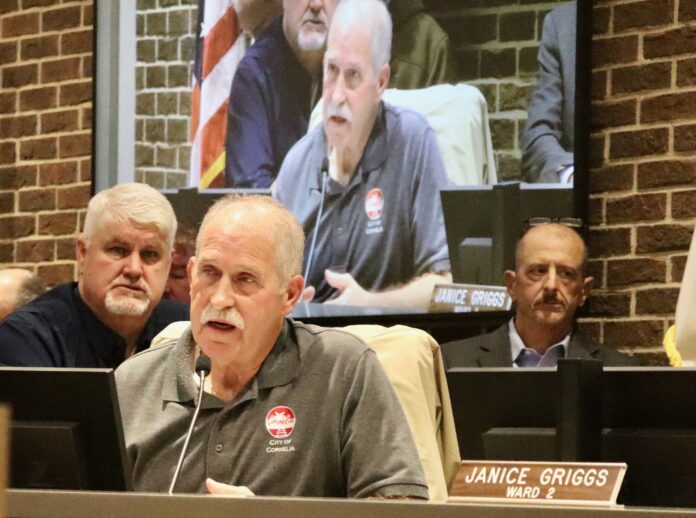
In the end, Commissioner Mark Reed — one of the proposal’s most vocal supporters — moved to repost the annexation ordinance for public hearing, a procedural step required because the city discovered a clerical error in the ordinance it previously advertised. When no commissioner seconded the motion, it died immediately, leaving the annexation with no legal path forward.
The vote’s collapse also killed a companion measure — the Development Assistance Real Property Interest Acquisition Ordinance — which several speakers warned could expand the city’s ability to acquire private property interests, including for development.
The historic reversal came after more than three hours of testimony, often emotional, sometimes angry, and occasionally applauding or jeering despite efforts to maintain decorum.
Mayor Borrow: “We’re not snakes… nobody’s hiding anything”
Before public comment began, Mayor Borrow delivered an extended defense of the city’s planning process and its intentions. He said the annexation reflected years of input gathered during required five-year comprehensive plan updates.
“We’ve met with hundreds — maybe even a thousand — people over the past five years,” Borrow said. “We hear from teachers and nurses who say they’d like to live in Cornelia but can’t afford to. We understand there’s a national housing crisis, and one way cities can address that is by allowing higher density.”
He also sought to dispel persistent rumors that the project included a data center.
“A data center isn’t even an allowed use in Cornelia,” he said. “It was on a developer’s wish list, but it can’t happen. It’s not in our ordinance.”
Borrow grew emotional discussing personal attacks on social media.
“People have called me a snake. They say ‘follow the money.’ My salary as mayor is $400 a month, and my wife and I donate it to churches and charities,” he said. “We’re not hiding anything. We’ve live-streamed meetings since COVID. Newspapers have been coming since the dawn of time.”
Borrow promised civility throughout the meeting.
“Even if I disagree with you, I’m not going to shout you down,” he said. “This is your forum.”
Residents rail against growth: crime, traffic, infrastructure, community identity
The vast majority of the night’s speakers opposed the annexation, many warning that the proposal would irrevocably change Habersham County.
Security consultant warns crime will rise
Clarkesville resident Carrie Brown, a security consultant of 35 years, said concentrated housing would bring crime.
“For every 100 homes, you’re going to have about 10 more crimes,” Brown said. “I’m not talking about theft — I’m talking about home invasions, the ones that are hard to stop.”
She pleaded with commissioners:
“People moved here for the beauty and the small-town feel. Don’t let this become like Gainesville.”
Level Grove resident: “We’re not ready”
Kathy Crain, a lifelong Level Grove resident, described long-standing infrastructure problems.
“The sewage system down there stinks — they call it ‘S-H-I-T creek.’ Sometimes you can smell it,” she said. “Level Grove Elementary is at full capacity. And it takes me 30 minutes to get out of my driveway during school time.”
She also suggested the tract at 1900 Level Grove Road may contain deed restrictions originally tied to church use.
Longtime resident: “Please don’t turn us into Hall County”
Janet Byrom, who moved to Habersham County in 1999 after living in crowded military housing, said dense development would destroy the character of the area.
“If you want to see what concentrated housing looks like, go to Gainesville. Apartment complexes turn into trash homes in five years,” she said. “Please don’t turn us into Hall County.”
Elderly residents being pressured?
Donna Shirley, 70, said developers had approached numerous elderly landowners in the
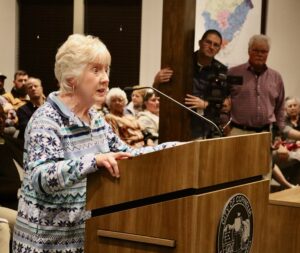
Mud Creek and Level Grove areas.
“They don’t need to be preyed on by greedy developers,” she said. “This is aggressive growth we don’t need.”
Elected officials from other cities warn Cornelia of legal and policy dangers
Two elected officials — one from Alto, one from Baldwin — made extraordinary public statements against the annexation.
Alto Councilman Allen Fox: “Eminent domain is a dangerous tool”
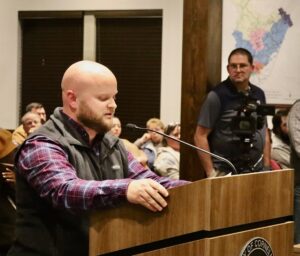
Fox sharply criticized the related real-property acquisition ordinance, warning it could enable future condemnation tied to private development.
“Private property rights are not partisan — they unite people across political lines,” Fox said. “Just because something is legally possible does not make it right.”
He warned the ordinance could be abused by future leaders:
“Power granted today can absolutely be abused tomorrow,” Fox said. “My family owns 21 acres just half a mile from the city. We have no intention of selling. A future administration could see land like ours and use this ordinance in ways no one here supports.”
Baldwin Councilwoman Alice Venter: “This could be a big mess”
Baldwin Councilwoman Alice Venter, who works in real estate, challenged the legality of the annex’s keystone tract at 1900 Level Grove Road.
“I have seen the original deed,” she said. “There are contractual conditions that run with the land. I can’t say how I know this, but that property has already been under contract — and the title work did not come back clear.”
She warned the council:
“Any challenge to that title could put the city in a difficult position and possibly nullify the annexation,” she said. “This could be a big old mess.”
Venter also said Cornelia must consider its role as a regional leader.
“Cornelia is a big brother to the greater community,” she said. “Please remember we’re all in this together.”
Business owner: “We’re not Dawsonville, and we don’t have to become it”
Local business owner Emily Herron said her fears came from watching Dawson County, Forsyth County, and Gainesville transform through rapid subdivision development.
“You can’t recognize Dawsonville anymore,” she said. “Once the bulldozers come and the concrete is poured, you can’t put the cat back in the bag.”
She told officials:
“You’re not beholden to a strategic plan. You’re beholden to your voters — not developers, not GMA, not the Georgia Initiative for Community Housing.”
Developer defends project: “We match the comprehensive plan”
After more than three hours of opposition, developer Keith Cook of Cook Construction addressed the chamber.
Cook said misinformation had fueled public anger.
“We’re not advertising this project anywhere — including in Virginia,” he said. “That rumor
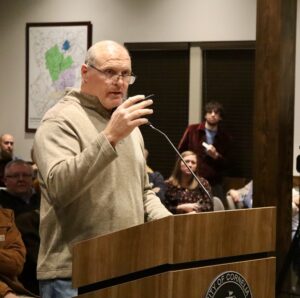
is totally untrue.”
Cook argued that the plan aligns with the city’s own comprehensive plan.
“You can overlay our project, and it will match that comp plan,” he said. “We are bringing affordable housing, good shopping, and good jobs.”
He disputed claims that the project would overwhelm schools:
-
Habersham County has 18,774 residential units
-
7,204 students total
-
A ratio of 38.4 students per 100 homes
His project’s 113 residential units would add about 40 students, he said.
Cook said the project would unfold over a decade.
“It will take two years just to engineer,” he said. “This will not be built overnight.”
He also emphasized work with GDOT on turn lanes, Duncan Bridge Road improvements, and future flyover concepts.
City manager reveals fatal clerical error
After public comment closed, City Manager Donald Anderson outlined the annexation and rezoning request — 216.6 acres divided into PUD, agricultural, and highway business designations — and disclosed a critical error.
“There was a clerical error in the proposed ordinance,” Anderson said. “If you choose to move forward, you will have to repost the ordinance.”
That meant the commission could not take action Tuesday without first voting to repost the corrected ordinance for public notice.
Commission declines to continue — annexation dies on the floor
Commissioner Mark Reed, who had defended the project earlier in the night, moved to repost the ordinance for public hearing.
No one seconded.
The motion died.
So did the annexation.
So did the related real-property acquisition ordinance that had generated controversy.
A packed room fell silent, then erupted in applause.
Council moves on to other business
After four hours, the commission shifted to routine agenda items:
LEOP adopted
Cornelia approved the Habersham County Local Emergency Operations Plan, the same plan adopted by Mt. Airy the night before.
2025 Budget adjustment
Cornelia amended its 2025 budget after collecting more hotel-motel tax revenue than projected.
Adjustments included increasing revenues by $60,000 and modifying multiple capital fund expenditure lines.
The meeting adjourned shortly before 10 p.m.
A turning point for development in Habersham County
Tuesday’s outcome represents a rare moment in local politics: a major development proposal falling not by a vote, but by lack of support to even continue the process.
It also marks a significant victory for residents who spent weeks organizing, speaking out, and pressing neighboring officials to intervene.
Whether Cook Construction revises or withdraws the project entirely remains unclear.
But for now, the most ambitious growth plan in Cornelia’s recent history is over.