
I shook Abigail Bennett’s hand and noticed the pink sweater first, soft and unassuming. She carried herself like someone used to listening closely. She looked young, but not at all uncertain. The kind of confidence that comes from having done the work.
Abigail, a student at the prestigious William and Mary University, did not come to Cornelia to unveil a finished mural or sell a prepackaged vision. She came because she was invited to help residents shape history and culture into color and definition. Audrey Davenport organized her arrival not as a guest appearance but as a collaboration.

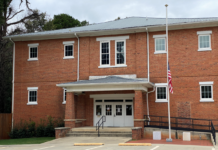
Audrey first encountered Abigail during a webinar, where a question about revitalization without displacement revealed a shared passion. How can public investment honor a neighborhood without hollowing it out? That question carried Abigail from North Carolina to a room at Cornelia City Hall.
Brushstrokes of Change
Although the gathering took place in City Hall, there were no votes or resolutions: The podium became a place for stories rather than statements. Cornelia City Manager Dee Anderson was there along with a few others. The mood felt more like a workshop than a presentation, a space where unfinished ideas still mattered.
Audrey opened the evening by framing the project not as a single mural, but as an ongoing process. Brushstrokes of Change, she explained, turns stories into landmarks — not monuments imposed from above, but symbols shaped by the people who live with them.
The murals planned for Jim Smith Park are only one part of that work. The other is Parking Spaces to Community Places, a companion project built around a simple question: What can underused spaces become? Even a big, overlooked parking lot can be something more — a gathering place, a children’s fair, a block party, a garden, a place that belongs to people when the cars are gone.

Honoring memories and legacies
Bennett spoke about her work with CASA, where a mural emerged through intentional dialogue with the people it represented. She shared early sketches, deliberately rough, faces suggested rather than fixed, surrounded by words like care, courage, family, education, and love. The goal was not polished. The goal was participation. As Bennett explains, “a mural fails when it reflects only the artist.”
One of the meeting’s goals was to propose concepts for murals at Jim Smith Park, located across from Shady Grove Baptist Church. These works of art are intended to preserve and honor the memory, history, and cultural legacy of Cornelia’s historically Black neighborhoods; accordingly, the murals under discussion should reflect and represent that heritage.
The work continues

The Jan. 8 meeting at Cornelia City Hall was just the beginning. The work continues with more events planned to finalize concepts. The community is invited to be part of that planning.
A memory-mapping workshop is scheduled for 1 p.m. on MLK Day, Jan. 19, at The Cafe on Martin Luther King Jr. Drive. Residents are encouraged to come share their stories and bring photos of The Hill.
“Help remember and call the names of our community pillars that uplifted our neighborhood,” encourages Davenport. “Mapping will involve recalling what houses we once had and the families that lived there.”
Information gathered at the mapping workshop will be used to create images for murals. Time will also be devoted to discussing the Parking Spaces to Community Places project.
Another community gathering is scheduled for February 19 at 5:30 p.m. at Cornelia City Hall.
As the meeting room emptied on Jan. 8 and conversations lingered, one thing felt clear: Brushstrokes of Change, funded through a Vibrant Communities grant from the Georgia Council for the Arts, is not about the mural itself, but rather the method. Hence, the invitation remains open. The work continues. And the city, for a moment, feels unfinished in the best possible way.
Interested in joining the conversation? Follow this link HERE.