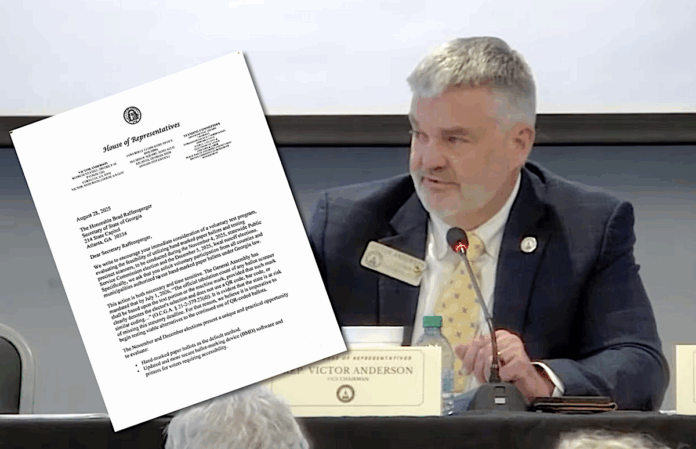
State Rep. Victor Anderson (R-Cornelia) is urging Secretary of State Brad Raffensperger to launch a voluntary pilot program this fall that would test hand-marked paper ballots and updated voting technology ahead of Georgia’s 2026 election law deadline.
In a letter sent to Raffensperger and signed by Rep. Tim Fleming (R-Covington), Chair of the House Blue Ribbon Study Committee on Election Procedures, Anderson encouraged immediate consideration of the program during the November 4 Public Service Commission election and the December 5 local runoffs. He asked that Raffensperger solicit voluntary participation from counties and municipalities authorized under Georgia law to use hand-marked ballots.
Statutory deadline approaching
Anderson, who chairs the House Governmental Affairs Committee, cited a looming deadline in state election law that requires all official tabulations to be based on the text portion of the ballot, rather than QR codes or barcodes, by July 1, 2026.
“It is evident that the state is at risk of missing this statutory deadline,” Anderson wrote. “For that reason, we believe it is imperative to begin testing viable alternatives to the continued use of QR-coded ballots.”
According to Anderson, the November and December elections present a “unique and practical opportunity” to evaluate the following:
- Hand-marked paper ballots as the default method.
- Updated and more secure ballot-marking device (BMD) software and printers for voters requiring accessibility.
- Updated scanner software compatible with the improved BMD systems. Ballot-on-demand printing technology.
- Compatibility and accuracy of ballot-on-demand printed ballots with optical
scanners. - Operational data, including training requirements, voting times, ballot printing costs, labor costs, and voter satisfaction.
The December runoffs, he said, could serve as a follow-up pilot, refining lessons learned in November.
Fractured state election board spotlighted in hearing
Anderson’s letter comes as he plays a key role in the House Blue Ribbon Study Committee on Election Procedures, which held a contentious hearing August 28 at North Georgia Technical College in Clarkesville.
The meeting revealed deep fractures within the State Election Board (SEB), with accusations of dishonesty, partisanship, and dysfunction dominating testimony. Some witnesses called for a structural overhaul, while others cautioned against rushed reforms.
“We knew there were issues within the SEB,” Anderson said, “but we didn’t realize until testimony how deep the fractures run. Legislative action may be needed to repair these issues, and our committee will prepare recommendations to improve the processes, effectiveness, transparency, and accuracy of elections in Georgia.”
Anderson added that election reforms must “promote trust, confidence, and participation.”
Committee work continues
Anderson serves as vice-chair of the committee, which is holding six hearings across the state. In addition to the Clarkesville hearing, previous sessions took place in Atlanta and Rockmart. Upcoming meetings are scheduled for Savannah on September 18, Covington on October 2, and Americus on October 16.
All hearings are open to the public and are livestreamed. The committee will submit its recommendations to the House Speaker ahead of the 2026 legislative session.
RELATED
Inside Georgia’s Election Board crisis: Clashes, conflicts, and calls for reform