
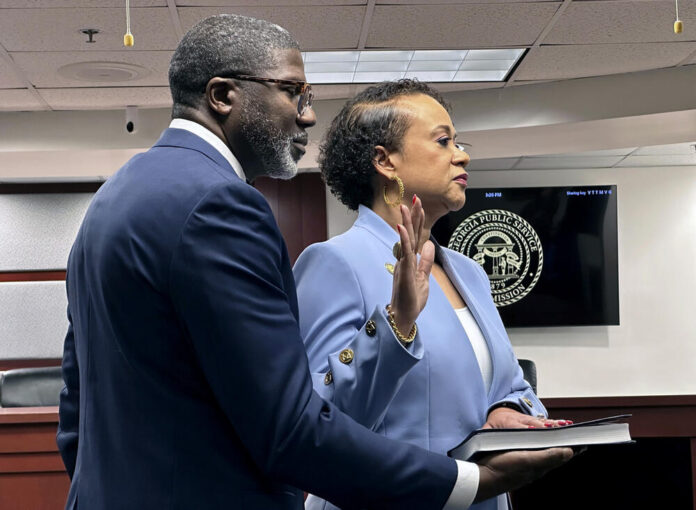
ATLANTA (AP) — Alicia Johnson became the first Black woman elected to a statewide post that isn’t a judgeship in Georgia when she won election to the state Public Service Commission. She assumed the post on Thursday, Jan. 1, along with fellow Democrat Peter Hubbard.
Johnson held a ceremonial swearing-in on Monday, Dec. 29, in the commission chambers in Atlanta, surrounded by family, friends and supporters. She called her election a “historic milestone.”
“I think that anybody who does something for the first time has a — you know it could be an overwhelming sense of responsibility,” Johnson told reporters. “It’s a shame that a commission that has over a 100-year history, that I’m the first anything on it. But the reality is, that’s who we are.”
Johnson and Hubbard won blowout victories over incumbent Republicans Tim Echols and Fitz Johnson in November, becoming the first Democrats elected to a state-level statewide office in Georgia since 2006. Their wins were powered by public discontent over rising electricity bills and data center development. Georgia’s Public Service Commission regulates the rates charged by Georgia Power Co. With 2.7 million customers, the unit of Atlanta-based Southern Co. is the state’s only private electrical utility.
Johnson is the first Black woman elected to a partisan office statewide in Georgia. Multiple Black women have won nonpartisan elections to statewide courts after being appointed by governors.
Georgia’s Public Service Commission had been made up of five Republicans, and a three-member GOP majority remains. Johnson said she has met with two of those Republicans seeking ways to work together.
“I accept this responsibility fully aware that the decisions made in this room and in this role affects families’ monthly bills, their community health, their economic opportunity and our shared future,” Johnson said.