

ATLANTA, Ga. — A rumor is spreading on social media that Georgia lawmakers have changed the law to make every driving under the influence (DUI) charge a felony.

Legal experts and state officials say this claim is false.
Under current Georgia law, a first or second DUI is a misdemeanor. This rule has not changed for 2025. While the penalties for driving impaired are strict, the state has not lowered the requirements for a felony charge to include first-time offenders.
Where the confusion started
The rumor likely comes from people misunderstanding laws about repeat offenders. In Georgia, a DUI usually does not become a felony until a driver is convicted of a fourth DUI within 10 years.
Lawyers say people often mix up “high and aggravated misdemeanors” with felonies.
“The majority of DUI arrests are misdemeanors,” states the Georgia Criminal Lawyer group. “But there are situations in Georgia where a DUI can be a felony.”
These experts explain that while a second or third charge carries jail time and license suspension, it does not take away a person’s right to vote or own a gun like a felony does.
The facts: What the law says
According to the Official Code of Georgia Annotated (O.C.G.A. § 40-6-391), the charges are broken down by how many times a person has been convicted:
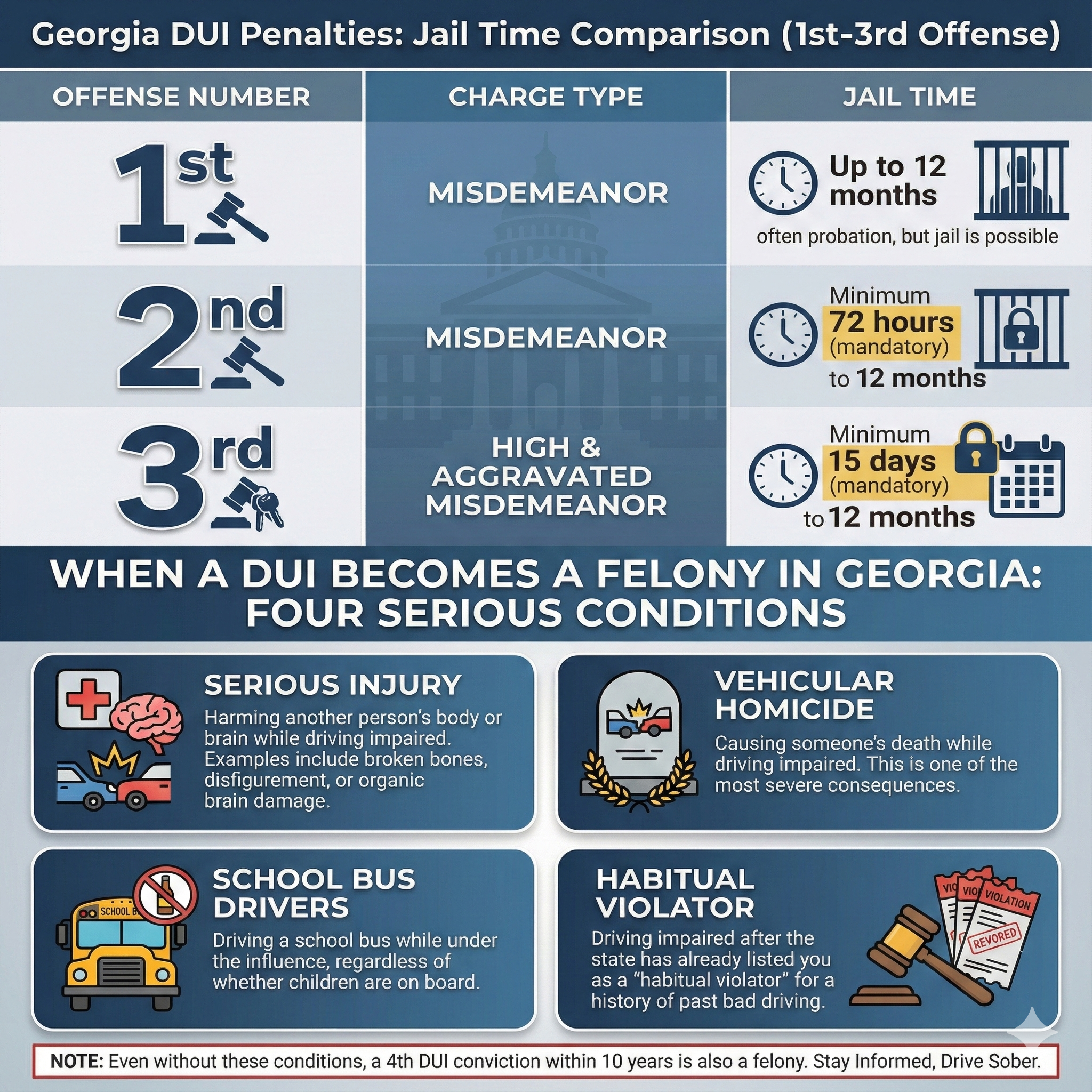
- 1st Offense (Misdemeanor): You may face up to 12 months in jail, fines up to $1,000, and 40 hours of community service.
- 2nd Offense (Misdemeanor): This brings mandatory jail time (at least 72 hours), higher fines, and license suspension.
- 3rd Offense (High and Aggravated Misdemeanor): This includes fines up to $5,000 and a mandatory 15 days in jail.
- 4th Offense (Felony): If this happens within 10 years of past convictions, it is a felony. This can lead to 5 years in prison.
When is a DUI a felony?
A standard traffic stop for impaired driving is usually a misdemeanor. However, specific actions can immediately turn a first charge into a felony.
“A DUI can be a felony if it is charged with serious injury by vehicle,” explains the law firm Rowsey & Stelter.
These serious actions include:
- Serious Injury: Harming another person’s body or brain while driving impaired.
- Vehicular Homicide: Causing someone’s death while driving impaired.
- School Bus Drivers: Driving a school bus while under the influence.
- Habitual Violator: Driving impaired after the state has already listed you as a “habitual violator” for past bad driving.
Why this matters
The difference between a misdemeanor and a felony is big. A felony conviction stays on your record forever and limits your civil rights.
Officials want drivers to know that, even though the “first-time felony” rumor is not true, current laws remain tough.
“Don’t get spun by internet rumors,” warns FactCheck.org. “Just because you read it on Facebook… doesn’t mean it’s true.”
Verdict: False
The claim that Georgia has made all DUIs felonies is not valid. The law stays the same: it takes four convictions or a serious accident to face a felony charge.