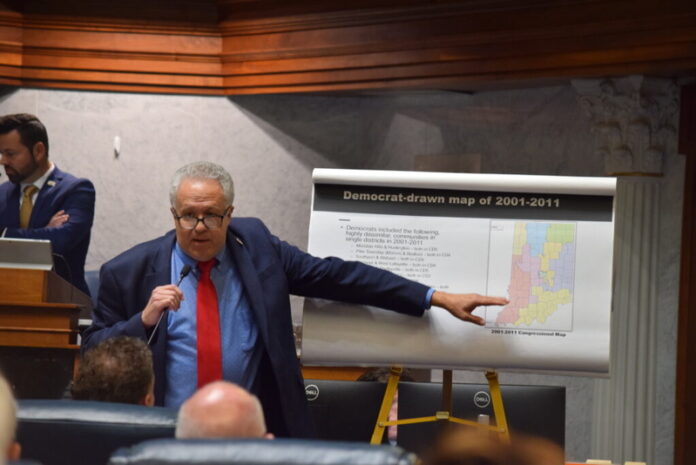
(Indiana Capital Chronicle) — The Republican-dominated Indiana Senate spurned months of demands from President Donald Trump as it voted 31-19 on Thursday to reject a redrawing of the state’s congressional maps.
The final outcome remained uncertain until 21 Republicans joined all 10 Democratic senators in blocking the redistricting plan. The proposal didn’t even win support from a majority of the 40 Republican senators.
With that tally, Indiana became the first Republican-led state Legislature to vote down Trump’s wish to squeeze out more GOP-friendly congressional seats in hopes of improving the party’s chances of keeping its slim U.S. House majority after the 2026 midterm elections.
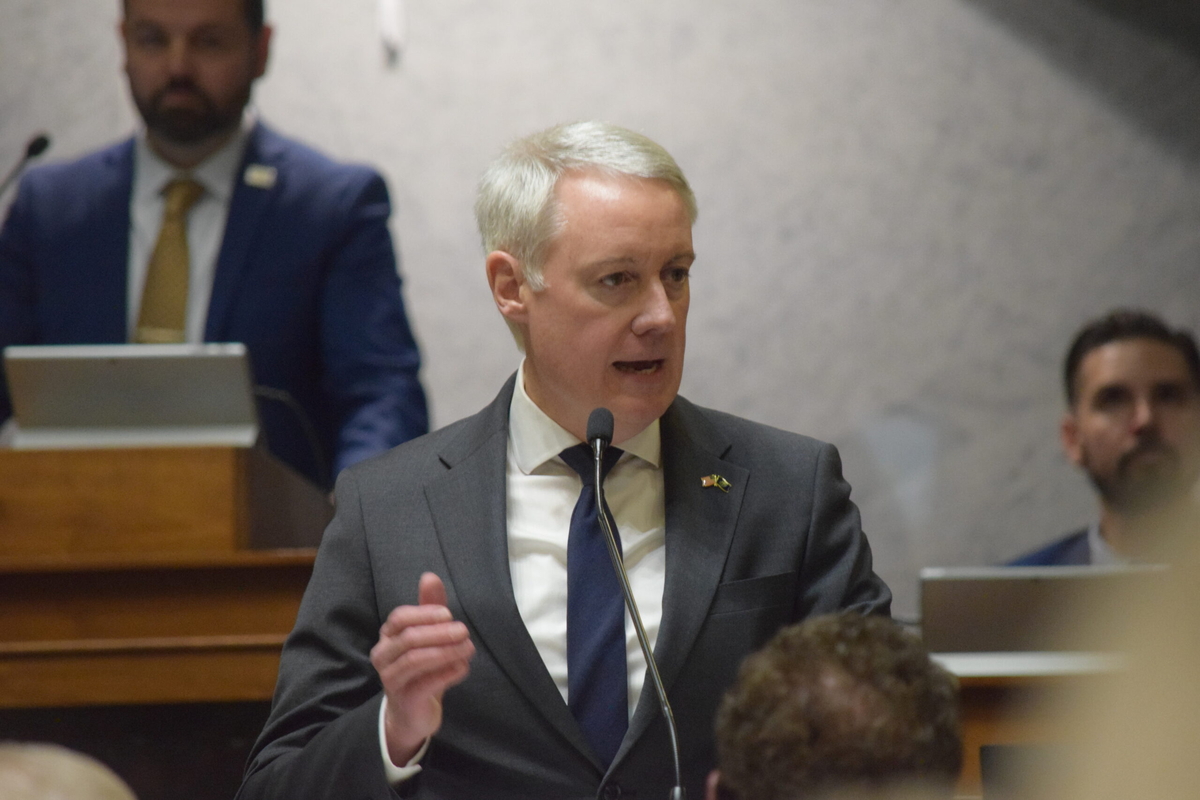
Thursday’s Senate outcome came even with Trump, Gov. Mike Braun and other redistricting supporters continuing to cajole — and politically threaten — senators who opposed the move.
“I am very disappointed that a small group of misguided State Senators have partnered with Democrats to reject this opportunity to protect Hoosiers with fair maps and to reject the leadership of President Trump,” Braun said in a statement following the vote. “Ultimately, decisions like this carry political consequences. I will be working with the President to challenge these people who do not represent the best interests of Hoosiers.”
The Indiana House last week approved the new maps crafted by the National Republican Redistricting Trust to produce a 9-0 Republican delegation. It did so by carving up the two districts currently held by Democratic Reps. André Carson in Indianapolis and Frank Mrvan in the area along Lake Michigan near Chicago.
But the Senate’s Republican leader, President Pro Tem Rodric Bray, had said repeatedly that too few GOP senators supported the mid-decade redistricting for it to pass.
“This is an extremely important issue that we’ve taken very seriously,” Bray told reporters after the bill’s defeat.
Bray downplayed the prospect of retribution from the White House after Trump and Vice President JD Vance publicly criticized him and other Republican senators.
“It’s their prerogative to have opinions about what we’re doing here. So, that’s fair,” he said.

Asked whether he was concerned about possible loss of federal funding or other consequences, Bray appeared unmoved.
“I’ve had lots of conversations with folks in Washington, D.C.,” he said. “Indiana will continue to function.”
A bill needs 26 votes for passage or defeat. Because a constitutional majority — 25 votes or more — voted against the measure, it can’t be taken up by state lawmakers again until the 2027 session.
Trump was calling individual senators this week seeking support and took to social media Wednesday night to seethe over Bray and other Indiana Republicans who weren’t following his demands.
Senator says ‘we can’t be bullied’
A crowd of about 100 protesters outside the Senate chamber echoed throughout the three-hour debate, chanting, “Fair maps now!” and “Vote no!” and “Cheaters!” and “Liars!” and “Just vote no!”
Brooke Isaac of Columbus and other protesters cheered the outcome, saying she was “very surprised and so very thankful.”
Isaac said she believed Trump was trying to use Indiana as a “pawn” to acquire power.
“I’m just really relieved that the Republicans and our government have decided to show integrity and to stand up for what the people in our state care about,” Isaac said.
Sen. Sue Glick, R-LaGrange, was among the senators voting against the new maps and said she believed the pressure and threats from Washington backfired.
“You have to know Hoosiers, we can’t be bullied,” Glick said. “We don’t want that. And the instant reaction is we dig in our heels and say, why?”
Indiana House Republicans pushed the proposed maps through that chamber last week by a 57-41 margin, with 12 GOP members joining Democrats in voting “no.”
Several Republican senators against the redistricting plan cited what they described as overwhelming public opposition. Others said they didn’t believe it was proper to overhaul the Republican-drawn maps approved in 2021 for such blatant political purposes, with some objecting to the overt gerrymandering of Indianapolis among four districts spanning as far away as the Ohio River.
Trump started the national redistricting fight by pushing Texas Republicans to redraw its congressional map this summer, followed by Republican redistricting moves in Missouri, Ohio and North Carolina. An attempt by Kansas Republicans for a special session on redistricting stalled this fall.
Democrats responded with their own redistricting in California and possible moves in Illinois and Virginia.
Bill sponsor called for Republicans to ‘fight’
Redistricting bill sponsor Sen. Mike Gaskill, R-Pendleton, used all of his 30-minute speaking time to argue in support of it after all 10 Democratic senators and three Republicans spoke in opposition.
“They want you to play by a different set of rules,” Gaskill said, referring to Democrats.
He called on his colleagues “to step up and do the right thing.”
“I want to see us on the Republican side fight as hard for our side as they do,” Gaskill said.
Sen. Greg Walker, R-Columbus — who has been outspoken against midcycle redistricting — called the bill “on its face, is unconstitutional.”
“I cannot, myself, support the bill for which there must be a legal injunction in order for it to be found constitutional,” he said.
Sen. Greg Goode, R-Terre Haute, had not announced a position before Thursday’s vote but told the chamber that “overwhelming feedback” from his constituents — “regardless of political leaning, or party affiliation” — influenced his decision. He ultimately voted no on the bill.
“I’ve done my very best to quietly and respectfully listen to the people I represent,” Goode said, “and I’m confident that my vote reflects the will of my constituents.”
At least a dozen legislators, many Senate Republicans — including Goode — have publicly disclosed being targeted in swatting attempts, bomb threats and more. The incidents have prompted an ongoing investigation now led by the Indiana State Police.
“Whether we realize it or not — whether we accept it or not — the forces that define these vitriolic political affairs in places outside of Indiana have gradually, and now very blatantly, infiltrated the political affairs in Indiana,” Goode said. “Misinformation, cruel social media posts, over-the-top pressure from within the Statehouse and outside. Threats of primaries. Threats of violence. Acts of violence. Friends, we’re better than this, are we not?”
Three Republicans — Sens. Liz Brown, Tyler Johnson and Chris Garten — all spoke in staunch support.
“The vote we are about to take is not just about lines on a map — it’s a vote of critical, epic proportion,” Garten said in his passionate remarks. “We’re not here to be neutral arbiters of decline. We’re here to be active agents of American greats.”